Have you ever heard of the “worship wars”? It seems we can’t please everybody as musical styles of western churches fragment ever more. Everybody has their own preference. Most evangelical revivals in recent centuries have produced new music praising God, yet most of the new styles were condemned by somebody as undermining the glory of God (note 1). Musical taste seems to be a culturally conditioned thing, mostly; whatever one grew up with first seems right. One of the most recent changes is that in the 20th century, rhythm replaced melody as the top consideration in popular church music for example, and it will be hard to go back (note 2).
However, when North American Mennonites witnessed the joy of people stirred by Methodist revivals in the 19th century, they wanted to sing the songs used in the prayer, protracted (that is, “lengthened”) and testimony meetings they experienced. Of course there were the Wesley brothers’ own wide-ranging doctrinal hymns and songs of experience (note 3), but there were also narrower camp meeting and gospel songs arising in the 19th-century context. This has been documented well by such people as Donald Hustad (note 4).
Some people are experts in evangelical, holiness and Mennonite music and hymnbooks, but I am not (note 5). As curator of the Missionary Church Historical Trust, I can report what we have collected as evidence of musical tastes in the Mennonite Brethren in Christ Church (1883-1947) and its successor the United Missionary Church (1947-1969) in Ontario (note 6). To a lesser extent, we can represent the Evangelical Association/ Church (1808-1946) and the Evangelical United Brethren (1946-1968) by a few songbooks and hymnbooks in the collection. I will survey those in a later blog. In this and some following articles, I will sketch some musical choices of some early EMCC members in Ontario, starting with a remarkable donation.

Courtesy Sherk Family
From the Eldon Troxel Sherk Collection. The MCHT received the personal collection of songbooks and hymnbooks (about 189 items) made from 1926 to the 1980s by the song leader and farmer Eldon Sherk (1905-1997) of the Bethel (New Dundee, ON) and Plattsville (ON) EM Churches (note 7). His first wife Aleda Coleman died in 1949, after which he married Evelyn Cressman.
The family says Eldon loved singing hymns. One of the beauties of his collection is that he not only bought and used dozens of books, he also collected the collections of earlier song leaders in Waterloo and Oxford County MBiC churches, thus stretching evidence for musical choices back at least to the 1870s when the predecessors of the MBiC came together, a period that itself stretches from about 1851 to 1883.
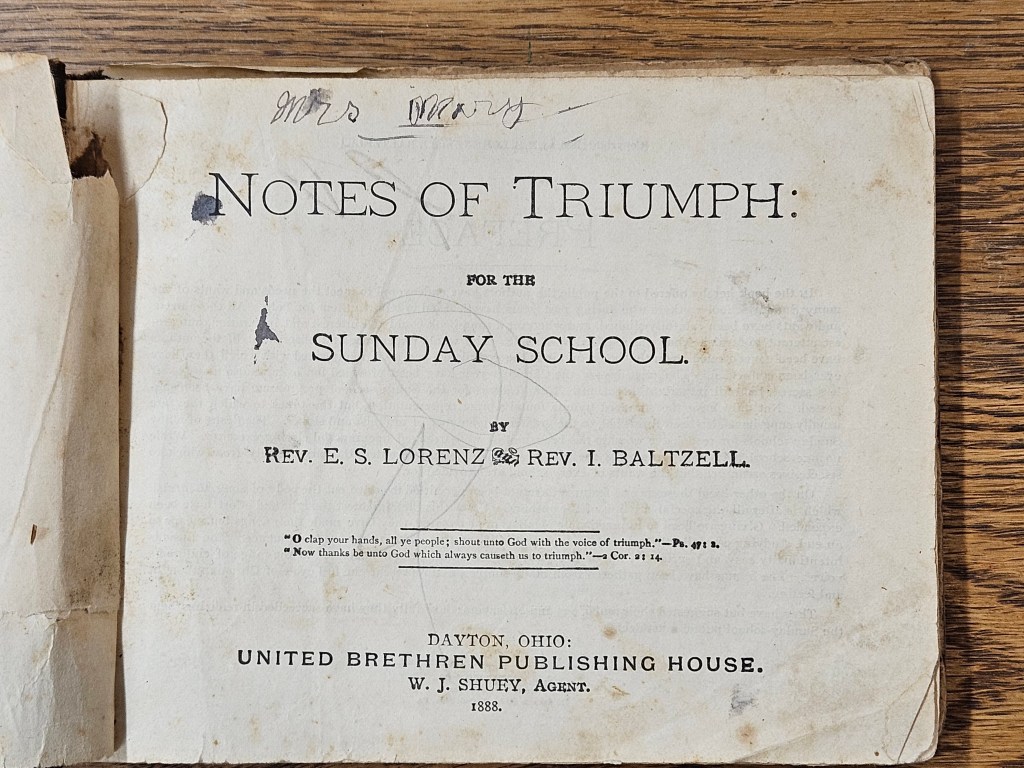
Courtesy Eldon Troxel Sherk Collection, Missionary Church Historical Trust
Sherk succeeded Moses Bock and his son Emerson Bock as the song leader on the New Dundee circuit (note 8) sometime after moving to a farm in Blenheim Township, Oxford County, in 1934. Eldon and his second wife Evelyn joined the new United Missionary Church congregation at Plattsville that the New Dundee church started in 1956. From the Bocks, Sherk received gospel song books published by Evangelical Association and United Brethren in Christ-related printers such as Balzell and Lorenz from the 1870s, and holiness publishers such as the Christian Witness Company and, from slightly later, Lillenas and Lehman (both related to the Church of the Nazarene). All but three of these books are in English, which is a little odd, since the first generation of the MBiC in Waterloo were certainly capable in German (note 9). The only exceptions were two Evangelical Association songbooks produced by Thomas and Mattill, Gebet und Danklieder 1 und 2 (from the1890s) and German Baptist Walter Rauchenbusch and Ira Sankey’s Evangeliums-Leider 1 und 2 (1897). Mennonite publishers were represented from across the 20th century.

Courtesy Eldon Troxel Collection, Missionary Church Historical Trust
Sherk collected the music owned by Jesse and Amelia (Zeller) Conner, from Markham, ON, and Breslau in Waterloo, respectively, who nevertheless were long-time members at Bethany Church in Berlin (Kitchener). Several of Amelia’s early books were decorated with Pennsylvania-German fraktur signatures. Jesse was one of those baptized by John McNally in the ice-bound water of Schneider’s Creek, now downtown Kitchener, in February 1878 (note 10). Sherk kept books inherited from his father and mother from Bethany, J Hubert Sherk and Lydia Troxel. He also added a few originally owned by his first wife, Aleda Coleman and other Coleman relatives from New Dundee, and later from his second wife, Evelyn Cressman and her relatives, also from New Dundee. In 1961 Eldon and Evelyn moved to a Wilmot Township farm and at some point after 1984 returned to attending Bethel in New Dundee. As a church pianist, Evelyn owned many Singspiration songbooks published by Zondervan from 1943 to 1971 intended for Sunday School use.
A half-dozen books were owned by brother and sister Alvin and Hattie Shupe of Blenheim Township, whose brother Morris was a song leader at New Dundee as well. Their family does not seem to be related closely with the famous Peter Shupe, singing teacher from Breslau. Eldon had second-hand books originally owned by as many as 21 people or organizations from around Waterloo County.
Sherk’s collection did not contain many solo pieces (note 11), though there were a number for duets, trios, quartets and even quintets. I guess this represents the Mennonite reluctance to display individual skill or perhaps his own choice not to perform as a soloist often. Most are hymnbooks intended for congregational worship and congregational aids, that is, supplements to congregational hymnbooks, more or less functioning as have CD samplers of new music recently. Sherk added works from more general evangelical publishers such as Rodeheaver and Inter-Varsity, or fundamentalists in the 1920s and 30s such as Tabernacle Hymns from Moody Church, Chicago, a favourite choice in MBiC churches. He also gathered from denominational publishing houses such as the Presbyterian Church of Canada, the Reformed Church of America and oddly the Latter Day Saints. Few books were from England or Canada; most were from the United States.
Many thanks to the descendants of Eldon Sherk for information about their father.
Next blog will feature the musical equipment and song leaders in the absence of musical instruments in the early EMCC of Ontario.
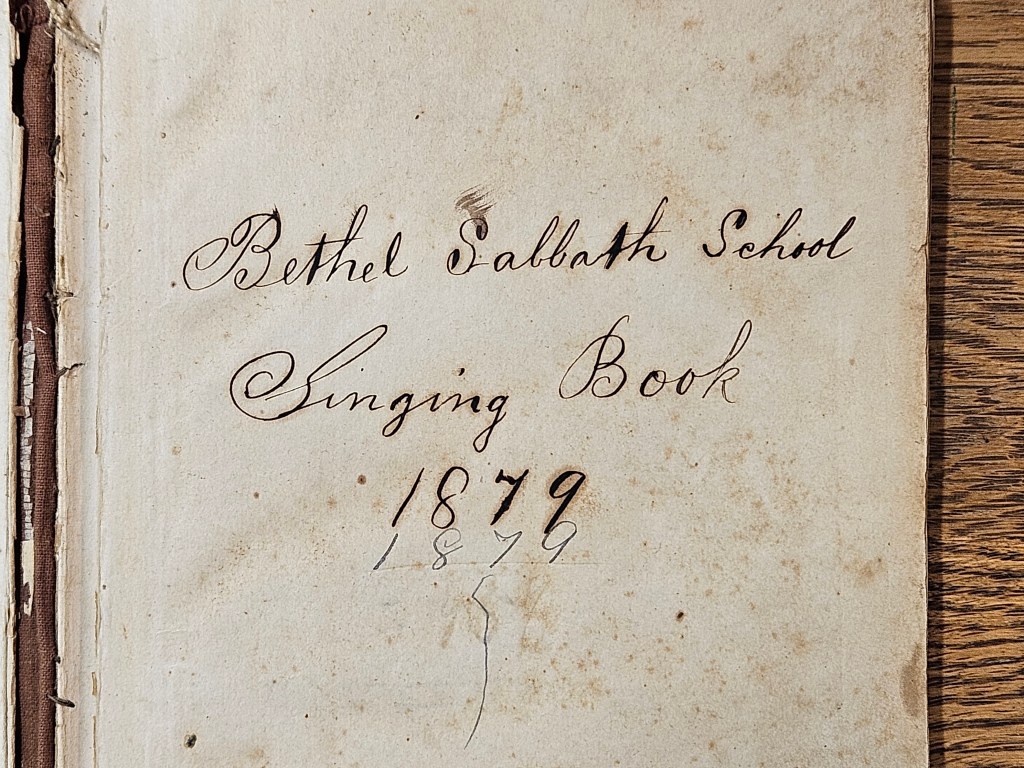
Banner photo: Inscription in Sabbath School songbook in Eldon Troxel Sherk Collection. Missionary Church Historical Trust. Author’s photo
note 1: I thought it was an anecdote of Luther which says he exclaimed, “Why should the devil have all the good music?” Wikipedia claims it was English hymnwriter Rowland Hill in the 18th century who said it first, followed by George Whitefield, and much popularized by Salvation Army’s General William Booth (and more recently Larry Norman.) https://en.wikipedia.org/wiki/The_Devil_Has_All_the_Best_Tunes#:~:text=Though%20this%20text%20credits%20the,hymns%20to%20popular%20secular%20tunes An example in the Missionary Church: criticism of a new chorus in an article in the Missionary Church magazine Emphasis sparked letters to the editor in early 1980: January 15, February 1 and 15.
note 2: In random support of this, articles in the Canadian Mennonite (November 16 2009): Leonard Enns, “Music as communion,” p 4-7; Christine Longhurst, “The rise of rhythm,” p 26; and the editorial by Dick Benner, “Endeared to four-part singing,” p 2.
note 3: The Missionary Church Historical Trust has an early example, a British edition of Wesley’s Hymns (ca 1846-1876) donated by Georgina Munk, but once owned by Martha Oates, possibly from St Just, a village in Cornwall, UK, where Bible Christians (a Methodist splinter group) were very numerous in the 19th century.
note 4: Donald Hustad, Jubilate II: Church Music in Worship and Renewal (Carol Stream, IL: Hope Publishing, 1993).
note 5: For example, the article by Ada Kadelbach, “Hymns Written by American Mennonites,” Mennonite Quarterly Review, or references in Samuel J Steiner, In Search of Promised Lands: A Religious History of Mennonites in Ontario (Kitchener, ON/ Harrisonburg, VA: Herald Press, 2015), especially p 159-163. More on Mennonite musical history can be found in the articles in GAMEO (Global Anabaptist Mennonite Encyclopedia Online), https://gameo.org/ .
note 6: See EMCC History home page on the top bar, “Formation of the EMCC” to disentangle all the denominational names in EMCC history.
note 7: Eldon’s parents farmed on land where a supermarket plaza is now at the corner of Weber and Fergus Streets in Kitchener, an area called Centreville. Sherk’s family also donated some of his holiness books as, for example, those by Jasper A Huffman.
note 8: The dispersed Bethel circuit included preaching appointments at Bright (Oxford County), Mannheim, Bethel (originally NW of New Dundee in the countryside until 1920), Roseville (all in Waterloo), and several other short-lived preaching points: Burford (Brant County), Innerkip (Oxford County), Poole (Perth County), New Hamburg and Baden (Waterloo County). By 1934 most of them were concentrated at the village of New Dundee.
note 9: Some Mennonite hymnbooks had supplements in German.
note 10: Everek R Storms, History of the United Missionary Church (Elkhart, IN: Bethel Publishing, 1958) p 227.
note 11: Rhea F Miller and Beverley Shea’s “I’d Rather Have Jesus” (1922) is one exception, with one copy for himself and one for a pianist. Sherk preserved several other songbooks in two copies, suggesting he provided for a soloist and accompaniment with other songs.

 EMCC History
Leave a comment