In modern jargon, I am “passionate” about the history of the Missionary Church.
That matters nothing, however, if God does not care about this denominational group.
The history of the Evangelical Missionary Church of Canada fascinates me, but why should it be to anyone else? Maybe it’s just my “thing” in this individualistic era of the world? I am Ontario-born and bred, but so are millions of others, and they have their own sub-communities.
How can the history of “our little society,” as an early leader called it, matter to the Lord Jesus Christ, Lord of the Church of all ages and traditions? Wouldn’t it be better to just wrap it up and sink it in the Great Lake of all Jesus-followers of the present? “Organized religion,” ptah!
Well, let me tell you a story. My family was quietly attending a church of one of Canada’s major denominations, when a series of upheavals led my parents to find another denomination. For a variety of reasons, which I have often had occasion to relate (note 1), we landed in a new congregation of the United Missionary Church, a denomination which I am sure my parents knew next to nothing about. This was in 1965. Except for the baby, all the older members of the family became “converts” within a few months. We became believers and followers of God in Christ Jesus as instructed in the Bible. I was baptized a week after my own prayer for the forgiveness of my sins. I joined the church a few months later. Over the next few years, the congregation discipled me, as we call it. And it was good.

note 1: Clare Fuller, “Waking Up in the Missionary Church,” Reflections Vol 13-14 (2011-2012) p 131-138.
In the church library, I found a history of the denomination, and actually read it. (note 2) Without orientation to church history, that was when I first heard about “Mennonites” and wondered if they were any relation to “Mormons” whom I had certainly heard about. I read that some early leaders had been put out of their Conferences, and wondered how that was possible. And was it good?
note 2: Everek R Storms, History of the United Missionary Church (Elkhart, IN: Bethel Publishing, 1958)
I don’t know why these experiences led me to curiosity about church history, and about the Missionary Church in particular. Over the years, I have found very few who care more than casually for the denomination’s story. After centuries of flourishing (and multiplying!), denominations are stagnating all over the western world, while flourishing and multiplying in the global South. Historians these days prefer to investigate movements and social trends, turning their backs on institutions. Theologically, the divisions of Christianity are treated as embarrassing and sinful, best buried.
But Does God Care? That must be the justification for attending to a small thing like the Ontario branch of a Canadian denomination, itself a branch of a world-wide fellowship. Though also small on a world scale, the Missionary Churches are part of evangelicalism, a currently discredited movement of the Church in the west, compromised by political worldliness, social accommodation and sins of its leaders.
Conviction Jesus loves the Church (Ephesians 5:25-26). “The gospel of Christ knows no religion but social, no holiness but social holiness,” said John Wesley (preface to Hymns and Sacred Poems (1739), as quoted in James Pedlar (note 3). Any expression of the Church is loved by the Lord of the Church. It is true that most of the New Testament’s references to “the assembly (ekklesia)” are to the local geographically-expressed Body of Christ (people or event) or to the whole Body of Christ throughout the world or even through all time (Hebrews 12:22-23). But there are evidences of regional churches: churches in Galatia addressed as a community (Galatians 3:1) or “the church throughout Judea, Galilee and Samaria,” (Acts 9:31) when there were congregations elsewhere. Ethnic groupings of believers are identified (Jews, Gentiles, Romans 15:27). The letter to the Romans addresses the entire Christian community in the capital city of the empire, not to “the church” in Rome to be sure (note Romans 16:5, “….the church that meets in their house”) but to the community of believers in the metropolis.
Loving the Church includes the believers and their associations in the past. I am always aware that some day I will meet the members of the Body of the Lord Jesus around the throne in the new heaven and the new earth (Ephesians 3:10, Revelation 6:9, “The Spirit and the bride say ‘Come!’…” Revelation 22:17). The nations, which come and go, will be there in some form (Revelation 21:24, 26, 22:2), why not the best of our assembled life?
note 3: James Pedlar, https://jamespedlar.ca/2011/09/22/john-wesley-and-the-mission-of-god-part-5-social-holiness/
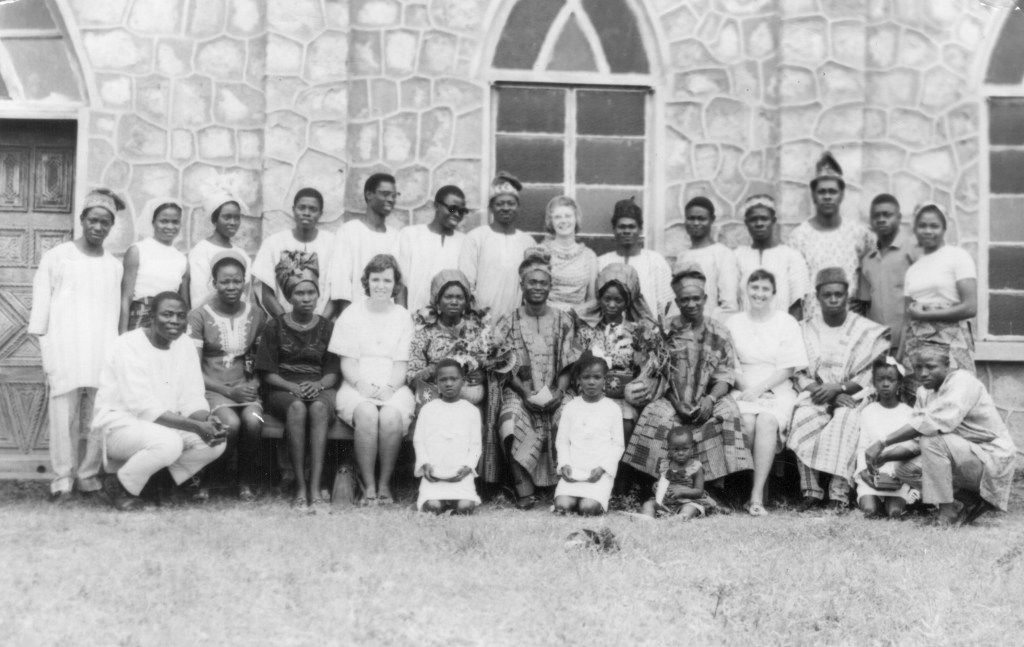
The Church is followers of Christ, not buildings. Wedding of Peter and Titi Isola at UMCA Jerusalem Church, Igbeti, Oyo State, Nigeria, ca 1972. Rev Dr Isola was a President of the United Missionary Church of Africa in the 1990s.
Courtesy: Joan Walsh Collection, Missionary Church Historical Trust.


 EMCC History
Leave a comment